
FAQs (Frequently Asked Questions)

Clarifications

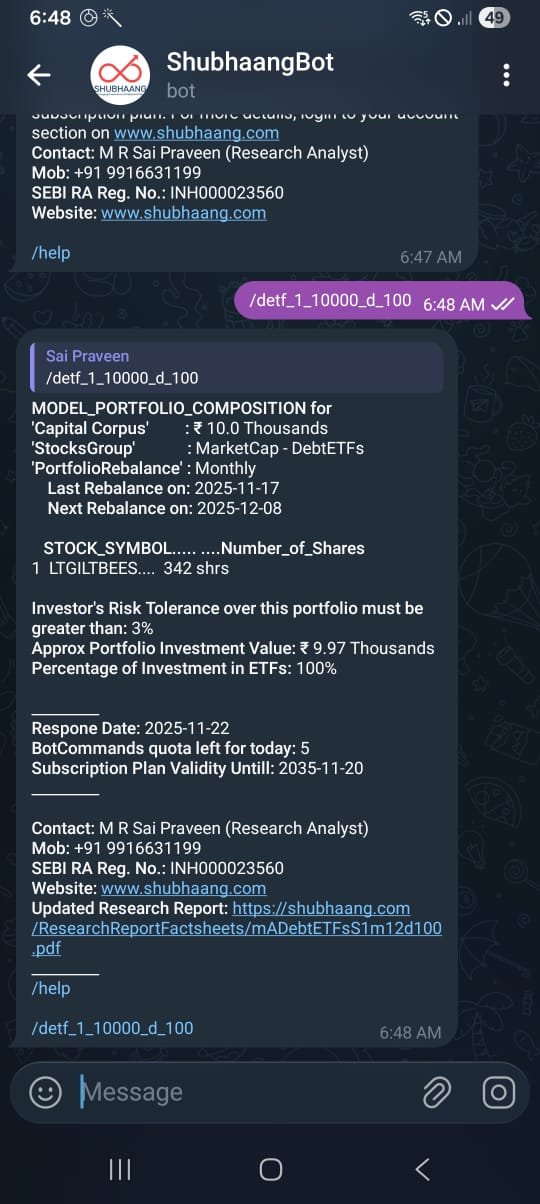
Refer to the illustrative image:

For example, if you send a text to the bot like:

/detf_1_10000

you are indicating that you want the portfolio to consist of Debt ETFs, with a total of 1 script for an investment capital of ₹10,000. (The precise stock group code and syntax required for your Model Portfolio to be sent to the bot @ShubhaangBot can be found in the research report linked to your subscription plan.)

In response, you will receive the Model Portfolio update details from the bot, which will include the following information:

  1. The complete code recognised by the bot based on your provided text message and other parameters from your subscription plan.

  2. Rebalancing details, including a) rebalancing frequency, b) last rebalance date, and c) next rebalance date.

  3. Portfolio composition, detailing script codes and the corresponding quantities (number of shares). Exact purchase prices are not significant and are not specified; scripts can be acquired at current market prices since the weightages for quantities have already been determined based on the latest prices from the last rebalancing.

  4. The risk tolerance required over the portfolio.

  5. The approximate investment amount needed to purchase all specified quantities of each script in the portfolio (this total will generally be below the stated available investment amount).

  6. ETFs composition (if applicable according to the subscription plan).

  7. Date of the rebalance update retrieved by the investor from the bot.

  8. Number of bot command attempts remaining for the user.

  9. Subscription plan validity.

  10. Contact details of the research analyst.

  11. Updated research report link for the model portfolio.
Subscription plans are available with monthly or quarterly rebalancing schedules, depending on the specific model portfolio you select.
Every model portfolio is built from a defined universe and follows a strict, rule-based mathematical framework. The specific rebalancing frequency is fixed and explicitly stated in the parameters of each individual plan before you subscribe.
To explore the available rebalancing frequencies and find a model that fits your operational preferences, follow these steps:
  1. Explore the Catalog: Head directly to the Portfolio Plans page.
  2. Review Plan Parameters: Open the “Filter” sidebar to refine the catalog based on your minimum investment capital, acceptable risk parameters, and preferred asset types (Pure Equities, Mutual Funds, or ETFs).
  3. Check the Schedules: As you browse the matching results, each plan’s title and description will clearly state its structured rebalancing timeline (e.g., Rebalancing Monthly or Rebalancing Quarterly).
Execution Tip: Implementing regular rebalancing updates manually can take time. If you want to simplify this process and bypass manually typing in scrip names and quantities every month or quarter, please review the detailed guide under the “Features” category of our FAQs titled “Can I implement your model portfolio rebalancing updates in my demat account with a single click?”. This guide explains how you can optionally and securely push your updated research weightages straight into your Zerodha webpage.
No, model portfolio updates are currently delivered exclusively through the Telegram app via @ShubhaangBot.
The Telegram bot is the only platform integrated with our secure cloud architecture to provide subscribers with 24/7 instant access to rule-based model portfolio updates, structural composition adjustments, and real-time rebalancing alerts. We do not transmit research recommendations via individual emails or WhatsApp messages at this time.
While we are continuously exploring alternative secure transaction-delivery networks for the future, all active communication remains centralized within the bot infrastructure to preserve data integrity and ensure you receive updates at the exact moment they are published.
To review the specific rebalancing frequencies or operational structures of our available research tracks before subscribing, please head directly to the Portfolio Plans page.
Execution Tip: Since research distribution occurs via Telegram, you do not need to worry about manually typing in company tickers or matching complex share allocations across platforms when updates drop. If you want to streamline your monthly or quarterly rebalancing execution securely, please review the detailed guide under the “Features” category of our FAQs titled “Can I implement your model portfolio rebalancing updates in my demat account with a single click?”. This entry explains how you can use our API connection to securely export your order details directly to your Zerodha webpage.

 
No, target levels and stop-loss levels are not provided with the model portfolio recommendations.
My research architecture relies strictly on quantitative, rule-based investment criteria designed for long-term capital compounding, rather than short-term technical price targets or stop-loss triggers. A scrip is maintained within a model portfolio as long as it continues to satisfy the specific fundamental and rule-based mathematical parameters of that particular strategy during its scheduled review.
 
When a monthly or quarterly rebalancing schedule is published via the Telegram bot, you will receive only the exact list of scrips and their precise, rule-based investment quantities based on your available capital. While you maintain full autonomy to set personal targets or stop-loss orders within your trading terminal, my system does not calculate or indicate specific price levels for these.
 
To examine the core asset parameters, holding turnures, and underlying rules of our active strategies, you can explore the complete catalog directly on the Portfolio Plans page.
 
Execution Tip: Because our portfolios do not use stop-loss levels and focus entirely on structural allocation changes, executing your regular rebalancing updates is straightforward. If you want to avoid manual entry completely when these changes occur, please review the detailed guide under the “Features” category of our FAQs titled “Can I implement your model portfolio rebalancing updates in my demat account with a single click?”. This guide explains how you can optionally and securely push your updated research quantities straight into your Zerodha webpage.
There is no rigid upper limit; a model portfolio designed for an investment capital above ₹20,00,000 can comfortably accommodate large-scale capital allocations up to ₹20 crores.
 
The minimum recommended capital stated on each plan is primarily an operational guideline. Higher initial capital simplifies the process of achieving optimal, precise stock weightings across the scrips without fractional share distortions. Furthermore, setting a clear minimum capital tier ensures that the fixed annual subscription fee remains structurally appropriate and cost-effective relative to your total investable asset size.
 
As an investor, you maintain full autonomy to deploy any amount of capital beyond the minimum recommended baseline. The quantitative rules and rebalancing frameworks governing the portfolio remain completely robust and scalable even at higher wealth tiers.
 
To review the exact relationship between capital baselines, portfolio sizes, and subscription tiers across our active catalog, please visit the Portfolio Plans page.
 
Execution Tip: When deploying larger amounts of capital across an equity portfolio, managing precise transaction values manually can be challenging. If you want to bypass manual typing and avoid calculation errors during your monthly or quarterly rebalancing, please review the detailed guide under the “Features” category of our FAQs titled “Can I implement your model portfolio rebalancing updates in my demat account with a single click?”. This entry outlines how you can securely export your updated research quantities directly to your Zerodha webpage.

 
If you miss a scheduled monthly or quarterly rebalancing update, your existing holdings will simply remain as they are in your personal demat account. While this may not result in immediate or significant losses, it will cause your portfolio to diverge from the rule-based research model.
Missing a rebalancing update can impact your investments in the following ways:
  • Deviation from Strategy (Tracking Error): Our model portfolios follow strict, data-driven mathematical rules. Typically, a portfolio of 10 stocks may undergo a composition change of 10% to 30% during a scheduled review to adjust for changing market parameters (this turnover percentage tends to decrease as the total number of stocks in a portfolio increases). By not executing the update, your portfolio stops aligning with the intended strategy.
  • Missed Growth Opportunities: Rebalancing updates are designed to exit scrips that no longer meet the model’s core criteria and reallocate that capital into fresh research selections. Delaying the update means you miss out on these new allocations.
  • Altered Risk Profile: Stocks that have grown significantly may now carry a higher weightage in your account than the strategy intends, while underperforming assets remain unaddressed. This can inadvertently alter the overall risk structure of your portfolio.
For optimal alignment with the research objectives, it is highly recommended to execute your updates through your broker terminal within a few days of receiving the notification from @ShubhaangBot. To review the core timeline rules and parameters of our active strategies, you can explore the complete catalog directly on the Portfolio Plans page.
Execution Tip: If manual rebalancing feels time-consuming, you can use our secure developer API link to bypass manual entries. For complete step-by-step instructions and data safety rules on this process, review the FAQ entry under our “Features” category: “Can I implement your model portfolio rebalancing updates in my demat account with a single click?”, which explains how you can optionally push your research weightages straight into your Zerodha webpage securely.
 
As a SEBI-registered Research Analyst, I do not promise, assure, or guarantee any specific rate of return. Equity investments are subject to market risks, and performance fluctuates based on market conditions. Some years may yield positive returns, while others may result in flat, marginal, or negative returns.
If you have a short-term investment horizon of less than 3 years, equity portfolios are generally not suitable. For short horizons, debt-based market instruments—such as debt ETFs or specific short-duration debt mutual funds—should be preferred over equity portfolios. However, please note that even debt market instruments carry a considerably higher risk of capital volatility compared to traditional fixed-income options like bank Fixed Deposits (VDs) or government bonds. Generally, equity-based model portfolios are suitable only for long-term investors with an investment horizon of at least 3 to 5 years, focusing on capital growth over an extended period. Past performance is not indicative of future results.
Our fixed fee structure for research services is as follows:
  1. Individual Clients: Annual subscription fees range from ₹100 to ₹1,51,000, depending on the specific model portfolio or membership plan selected.
  2. Institutional Clients: Fees are charged at a flat rate of 2.5% of the investable capital.
All fees are fixed and charged upfront before subscribing. In strict compliance with SEBI regulations, we do not offer any profit-sharing, performance-linked, or variable fee models. To review all our subscription tiers and parameter combinations, you can visit the Portfolio Plans page.
Execution Tip: Once you select a suitable plan and complete your onboarding, all rebalancing updates will be delivered directly through @ShubhaangBot. If you want to simplify your periodic rebalancing adjustments and avoid typing scrip details manually, please review the guide under the “Features” category of our FAQs titled “Can I implement your model portfolio rebalancing updates in my demat account with a single click?” to see how you can optionally transmit your research weightages straight to your Zerodha webpage securely.
 
No, I do not track your personal bank account balances, broker holdings, or individual transaction costs. My service provides pure model portfolio research based on data-driven, mathematical rule sets rather than custom technical price alerts. When a scheduled monthly or quarterly review takes place, the updated composition metrics are sent uniformly via @ShubhaangBot. It is entirely your decision whether to adjust your holdings to align with the fresh research weightings. You can view our available model parameters on the Portfolio Plans page.
Yes, you can transition from an active Single Portfolio Plan to an annual Membership Plan at any point during your subscription timeline. Additionally, active Membership Plans can also be upgraded to a higher tier at any time upon request, as long as the parent membership remains active.
Transitions, cancellations, or modifications of existing plans are handled systematically through a formal email request sent to our support desk.
When your manual transition or membership upgrade request is processed, the system operates under the following structural framework:
  1. Email Request and Review: You must send an explicit transition or upgrade request from your registered email address to our support desk.
  2. Mandatory Prior Plan Cancellation: In order to generate your discount coupon, your existing active plan must first be completely cancelled on the website database. A unique discount coupon cannot be created while a plan remains active on your profile.
  3. Unique Coupon Generation via Pro-Rata Credit: Once the cancellation of your running plan is successfully processed on the website, the credit balance for your remaining unused subscription tenure will be calculated. This exact pro-rata value will then be converted into a unique discount coupon code and emailed directly to you.
  4. Paying the Adjusted Balance: When subscribing to your new Membership Plan on the website, you can apply this unique coupon code at checkout. This will deduct your pro-rata credit, meaning you only have to pay the remaining balance for the new subscription.
  5. Handling Excess Unutilized Credit: If the subscription fee of your new Membership Plan is less than the discount value applied, the remaining unutilized credit balance will be converted into a second discount coupon and emailed to you. This unutilized credit balance can be utilized in the future if you choose to upgrade to a higher-tier Membership Plan. The validity of this secondary coupon will match the remaining timeframe of your original cancelled plan; if left unutilized within that lifespan, the credit will be permanently forfeited and cannot be refunded.
  6. Continuous Upgrade Flexibility: If you are already on a Membership Plan and find that your investment scale or portfolio requirement expands, you are permitted to request an upgrade to an even higher-tier membership plan at any point during your active subscription. The same pro-rata credit calculation will be applied toward the higher plan’s fee.
  7. Strict Coupon Validity Rules: Once a discount coupon is issued to you, it features a maximum validity period of exactly 2 days. The coupon must be utilized within this window; otherwise, it expires. If expired, you will have to send a fresh email request to initiate a new cancellation verification and generate a new code.
  8. Account and Email Specific Locks: These discount coupons are entirely unique to your registered email ID and your specific client profile. If these codes are applied to any other accounts, they will not function, and the stated discount will not be granted.
  9. Validity Rules for Sub-Portfolios: Once your new Membership Plan is active, the validity of any model portfolios you choose to activate under its umbrella will be bound strictly to the expiration timeline of the main parent Membership Plan.
  10. Subscription Limits and SEBI Compliance: A client cannot maintain more than one active Membership Plan simultaneously. Furthermore, you cannot activate any portfolio combinations or subscription structures that would result in collecting more than the specified SEBI annual regulatory fee limits from an individual client within a single year.
To browse our membership tiers, asset structures, and current fee options before initiating your email request, please visit the Portfolio Plans page.
 
Step-by-Step Guide to Upgrade to a Membership Plan
To upgrade your active subscription via the manual coupon route, please follow these operational steps:
  1. Submit an Email Request: Send an explicit request to transition your plan from your registered email address to support@shubhaang.com
  2. Await System Cancellation: Support will review your request and manually cancel your active Single Portfolio Plan on the website platform.
  3. Receive Your Coupon Code: Once the website cancellation is complete, the system will generate a unique discount coupon code representing your calculated pro-rata credit, which will be emailed to you.
  4. Select Your New Tier Within 2 Days: Visit the Portfolio Plans page. Use the filter sidebar to find the specific annual Membership Plan that matches your total investable capital and annual strategy requirements. Ensure you proceed to checkout within 2 days of receiving your code before it expires.
  5. Apply Coupon at Checkout: Click “Subscribe Now” on your chosen Membership Plan to proceed to the checkout screen. Paste your unique discount coupon into the coupon code field and apply it to instantly subtract your pro-rata credit from the final fee.
  6. Execute Your New Client Agreement: Complete your paperless onboarding sequence, verify your profile criteria, and sign your fresh eSign client service agreement required under SEBI regulations.
  7. Complete the Adjusted Payment: Pay the remaining net balance securely via the provided UPI QR code engine to activate your fresh 12-month membership cycle.
  8. Deploy and Control via Telegram: Open @ShubhaangBot on your phone, go to Investment plans ➔ Membership plans, and select the multiple model portfolios you wish to run simultaneously up to your new plan’s specific cap.

  1.  

If the subscription fee of your new Membership Plan is less than the pro-rata discount value applied from your cancelled plan, the remaining unutilized credit balance will not be lost.
Instead, the leftover balance will be managed under the following strict system rules:
  1. Generation of a Second Discount Coupon: The remaining unutilized credit balance from your original coupon will be automatically calculated and converted into a second, separate discount coupon code. This new code will be generated and emailed directly to your registered email address.
  2. Future Upgradation Utility: This unutilized credit balance coupon can be utilized in the future if you choose to upgrade to a higher-tier Membership Plan. Active membership plans can be upgraded upon request at any time as long as they are active.
  3. Strict Validity Tied to the Original Plan: The validity period of this second discount coupon will be bound strictly to the original expiration date of your previously cancelled plan. It does not receive a fresh timeline.
  4. No Cash Refunds for Unused Balances: If this secondary coupon is not utilized to upgrade to an eligible higher-tier membership plan within its designated lifespan, the credit balance will be permanently forfeited. No cash refunds, bank transfers, or further extensions will be provided for any unutilized balances once that timeline passes.
To review our available pricing structures, capital limits, and fee categories before applying any credit codes, please visit the Portfolio Plans page.

Guidance

As a SEBI Registered Research Analyst, I cannot discuss, project, or indicate future returns or expected capital appreciation. Equity investments are subject to market risks, and promising specific targets or multipliers is strictly prohibited under regulatory guidelines.
Instead, you can find the right research model by aligning your exact criteria—a 30% risk tolerance and an 8-year investment horizon—directly with our filtering grid on the Portfolio Plans page.
To pinpoint your plan, expand the “Filter” sidebar on the page and check the boxes for your exact preferences across these categories:
  • Risk & Tenure: Select “Future Risk may Exceed 30%” and “8 or more years” to isolate portfolios structurally optimized to match your specific compounding timeline and volatility tolerance.
  • Capital & Fee: Select your exact investable surplus tier (options range from ₹10,000 to over ₹60 Lakhs) and your affordable annual advisory fee budget (from ₹100 to ₹1,51,000).
  • Asset Type: Filter for your preferred underlying instruments (Purely Equities, Mutual Funds, or ETFs) under the Portfolio Scripts Type section.
  • Portfolio Size: Choose how many underlying securities you want to hold within a single portfolio plan (ranging from 3 to 50).
  • Advanced Screeners (Scripts Group Titles): Narrow your search further by Market Cap (e.g., Micro Cap 500, Small Cap 250), Thematic Styles (e.g., High Dividend Yield, Low PE, Piotroski Score), or specific Industries.
Once you apply these criteria on the Portfolio Plans page, the system will instantly display the single most suitable individual portfolio or broad multi-portfolio membership plan for your situation.
Execution Tip: Once you choose a plan and subscribe, you will need to implement the model updates in your account. If you want to streamline this execution process without manually typing in scrip names and quantities every month or quarter, please review the detailed guide under the “Features” category of our FAQs titled “Can I implement your model portfolio rebalancing updates in my demat account with a single click?”. This guide explains how you can optionally push your research weightages straight into your Zerodha terminal securely.
As a SEBI-registered Research Analyst, I provide model portfolios and rule-based research recommendations; therefore, individual risk profiling is not applicable to my services. You maintain full autonomy over your investment decisions, and I cannot directly recommend or select a single “ideal” plan for you.
However, you can easily map your financial structure—a ₹3,00,000 current portfolio value, a ₹15,000 monthly contribution, an aggressive strategy preference, and a 10+ year long-term horizon—directly to our discovery grid on the Portfolio Plans page.
To find the research models that fit your operational parameters, open the page’s “Filter” sidebar and check the boxes across the following priorities:
1. Capital Allocation & Subscription Structure
  • Capital Filter: Under Minimum Annual Investment Capital, check the box for “Capital above ₹2,00,000” or “Capital above ₹3,00,000” to view configurations built to achieve precise stock weightings for your allocation scale.
  • Subscription Selection: With your current investable asset structure, you can either select a standalone Single Portfolio Plan or opt for a multi-portfolio Membership Plan (such as the Envoy or Emissary tiers). A Membership Plan gives you an umbrella subscription to activate and hold multiple model portfolios simultaneously.
2. Strategy, Risk & Horizon Configuration
  • Tenure Filter: Under Investment Commitment Tenure, check “10 or more years” to lock in models structurally configured for a decade-long compounding horizon.
  • Risk Parameters: Since you are comfortable with an aggressive investment style to optimize long-term CAGR growth, navigate to Possible & Acceptable Future Portfolio Risk and select the higher risk parameters (such as filters for risk benchmarks above 30%, 40%, or 50%).
  • Asset Type: Under Portfolio Scripts Type, select “Purely Equities” if you want to focus directly on direct stocks rather than mutual funds or hybrid market instruments.
3. Advanced Strategy Refinements (Scripts Group Titles)
To align with an aggressive equity approach, you can narrow your search further under the advanced section to isolate higher-beta or deep-value market segments:
  • MarketCap Rules: Filter for deeper sectors like Micro Cap 500, Micro Cap 250, or Small Cap 250 & Micro Cap 500.
  • Thematic Rules: Screen for high-conviction models under Theme (such as GrowthConfidence, FreshGrowth, or a Piotroski Score above 6/7).
Simply check these boxes on the Portfolio Plans page, and the grid will instantly isolate the exact plans matching your inputs. You can then select a plan that fits comfortably within your affordable annual advisory fee budget.
Execution Tip: Once your subscription is active, you will need to deploy your monthly SIP and rebalance your allocations. If you want to streamline this execution process without manually typing in company names and share quantities every month or quarter, please review our detailed guide under the “Features” category of our FAQs titled “Can I implement your model portfolio rebalancing updates in my demat account with a single click?”. This guide explains how you can optionally push your research weightages straight into your Zerodha terminal securely.

 
The issue is that there are no active portfolios in the catalog configured with an exact minimum capital parameter of ₹5,00,000. The screening matrix only allows you to select filter combinations that have an exact product match currently available. Looking at our active catalog tiers, the closest available capital options are “Capital above ₹4,00,000” or “Capital above ₹6,00,000”, meaning a standalone tier for exactly ₹5,00,000 does not exist.
To resolve this issue and see all your small-cap options on the platform, please follow these steps directly on the Portfolio Plans page:
1. Reset Your Filters
Click the “Reset All Filters” button at the top or bottom of the sidebar to clear your current selection.
2. Reverse the Priority Order (Select the Small-Cap Group First)
Instead of filtering by capital first, select your asset preference first so the system displays all available configurations:
  • Scroll down to the Scripts Group Titles section first.
  • Check the box for your desired segment, such as “MarketCap – Small Cap 250” or “MarketCap – Mid Cap 150 – Small Cap 250 & Micro Cap 500”.
3. Select a Lower Capital Tier
Once you check the small-cap group, look at the Minimum Annual Investment Capital section to see which tiers are highlighted. Since your capital is ₹5,00,000, you can comfortably invest in any portfolio that requires a lower minimum amount.
  • Select “Capital above ₹4,00,000”, “Capital above ₹3,00,000”, or “Capital above ₹2,00,000”. Your ₹5,00,000 allocation will easily meet and exceed these weightage requirements.
4. Alternative Choice: Use the Telegram Bot
If you prefer an automated setup, you can skip the website’s matrix entirely. Open our Telegram bot @ShubhaangBot, navigate to Investment plans, and select “Help me choose a plan”. The bot will process your ₹5,00,000 capital amount and your preference for small-cap stocks to recommend the most suitable individual portfolio plan or multi-portfolio membership tier (like the Envoy plan).
Execution Tip: Once you subscribe to your chosen plan and receive your model portfolio, you must deploy and rebalance your capital. If you want to simplify this execution process without manually typing in names and quantities every month or quarter, please review the detailed guide under the “Features” category of our FAQs titled “Can I implement your model portfolio rebalancing updates in my demat account with a single click?”. This guide explains how you can optionally push your research weightages straight into your Zerodha terminal securely.

 
Yes, you can align your Systematic Investment Plans (SIPs) with my model portfolios.
Because I provide rule-based research recommendations and do not manage or execute trades, your SIP will be managed manually by you inside your own personal demat account under the following framework:
  1. Determine Your Annual Capital Target: Calculate the total capital you intend to accumulate through your monthly SIP contributions over a 12-month period, adding any existing lump-sum capital you already have. Use this combined figure as your reference point for the Minimum Annual Investment Capital filter on our platform.
  2. Select and Subscribe to a Plan: Go to the Portfolio Plans Page and choose a subscription plan based on your calculated annual capital, acceptable risk, investment horizon, asset type, and stocks group.
  3. Deploy Capital: As you add fresh capital to your demat account each month through your SIP, you can update your total available investment amount within the Telegram bot.
  4. Accessing Updated Weightages: When you request your model portfolio, the bot will dynamically calculate and display the updated, rule-based stock weightings tailored to your latest capital amount. You can then use these updated figures to manually execute your purchases or rebalance your holdings through your stockbroker.
Execution Tip: To simplify manual typing and speed up your monthly execution, you can use our new one-click broker integration. Please refer to the FAQ under the “Features” category titled “Can I implement your model portfolio rebalancing updates in my demat account with a single click?” to see how to securely export your order details directly to your Zerodha terminal.

 
As a SEBI-registered Research Analyst, I provide model portfolios and rule-based research recommendations; my services do not include portfolio management, execution, or the direct handling of client funds. Consequently, I cannot directly set up, execute, or manage a Systematic Withdrawal Plan (SWP) for you.
Because my model portfolios are composed of equity instruments, regular or guaranteed monthly income cannot be expected or guaranteed. Equity markets are volatile, and drawing fixed monthly withdrawals against a pure equity portfolio can lead to capital erosion during market drawdowns.
However, if you have a significant amount of capital to invest for the long term, you can structurally manage your withdrawals independently using our platform:
  1. Select a Plan Based on Your Parameters: Head to the Portfolio Plans Page and select a subscription tier based on your initial capital, acceptable risk, and a long-term investment horizon (ideally 5 to 10+ years).
  2. Execute Withdrawals via Your Broker: You maintain full control of your funds within your own personal demat account. Any systematic withdrawals must be set up and executed directly through your stockbroker or banking platform.
  3. Managing Portfolio Weightages: If you choose to make periodic manual withdrawals from your capital, you will need to update your net available investment amount within the Telegram bot when accessing your model portfolio. The system will dynamically display the adjusted rule-based stock weightings matching your updated capital base, which you can then manually execute inside your demat account.
Execution Tip: When updating your capital base after a withdrawal, you can streamline the manual reallocation process. Check out the FAQ entry under the “Features” category titled “Can I implement your model portfolio rebalancing updates in my demat account with a single click?” to learn how you can optionally push these updated weightages directly to your Zerodha order menu.
Our model portfolio reviews operate strictly on predefined monthly or quarterly rebalancing schedules. There are no sudden, intra-week strategy modifications or flash alerts that require constant monitoring. An official notification will be transmitted automatically through the bot at the exact moment a scheduled update is finalized on our cloud servers. You can confirm the fixed rebalancing timelines for all individual models and membership options before subscribing by browsing our details grid on the Portfolio Plans page.
 
Execution Tip: Since updates are predictable and tied to your chosen monthly or quarterly timeline, we recommend executing the rebalancing changes within a few days of receiving the automated alert. Reviewing the detailed guide under this “Features” category regarding the optional Zerodha developer API link will show you how to securely push the fresh research basket straight to your Zerodha webpage to streamline the physical trade entry.

Issues

There are two primary reasons why your order status may still be marked as “On Hold”:
  1. Mandatory KYC Verification (Most Common): As a SEBI-registered Research Analyst, it is legally mandatory to collect and maintain PAN-based KYC records for all clients under SEBI regulations. If your self-attested PAN card has not been uploaded, your order will remain on hold.
  2. Payment Processing Lag: On rare occasions, there may be a technical delay before the funds successfully reflect in our banking system.
Since payment failures via UPI are minimal, the hold is almost always due to a missing KYC document.
 
How to resolve the hold:
Please navigate to the ‘My Orders‘ section on the portal and upload a clear, self-attested copy of your PAN card. For enhanced security, please write the current date and sign across the copy, explicitly stating: “Shared exclusively for onboarding with Shubhaang Research Services.”
Once your document is uploaded and verified, your order status will be updated automatically. You can check available plan structures or access your subscription requirements on the Portfolio Plans page.
 
Execution Tip: Once your onboarding is finalized and your subscription becomes active, your portfolio details will be sent directly via @ShubhaangBot. To make things easier down the line, please review the guide under our “Features” FAQ category titled “Can I implement your model portfolio rebalancing updates in my demat account with a single click?” to see how you can optionally export your monthly or quarterly research weightages straight to your Zerodha webpage securely.
 
The stock recommendations in your model portfolio automatically calculate the exact number of shares to purchase by factoring in the specific market prices and suggested weightings as of the last rebalancing date.
Because these metrics are structurally computed using math rules before delivery, the calculated quantities will typically process smoothly within your broker terminal without triggering execution errors.
However, if you experience unique technical anomalies or specific order restrictions, the system operates under the following structural framework:
  1. Predetermined Market Lot and Order Size Limits: The calculated quantities are highly unlikely to cross market boundary violations. However, if a less liquid stock features a specific minimum lot restriction, or if your requested quantity exceeds the maximum allowable units per order set by the exchange operator, the broker terminal may reject the transaction block.
  2. How to Manage Order Size Violations: If the rule-based quantities mentioned in your model portfolio exceed your broker’s maximum single-order limits, you simply need to break down the total required quantity for that specific scrip into multiple smaller orders or lots that match the acceptable per-order size.
  3. Liquidity and Universe Selection Stability: Because our underlying equity model portfolios are constructed exclusively from a stable pool of the top 1000 companies across the NSE and BSE (along with verified ETFs and mutual funds), core structural liquidity issues or execution failures are historically minimized.
  4. Handling Market Circuit Limits: Due to unexpected market fluctuations, a specific scrip may occasionally hit its daily upper or lower circuit limit. In these rare instances, orders for that specific stock will not go through on that trading day. You can resume implementation on a regular trading day once trading for that scrip unlocks.
  5. Direct Technical Support Escalation: Model portfolio compositions are calculated dynamically based strictly on the investment amount you input when interacting with @ShubhaangBot. If you face any persistent technical complications or broker placement errors, you can immediately contact the research analyst directly via WhatsApp or Telegram to receive a swift resolution or operational clarification.
To review your active plan criteria, required capital baselines, or baseline strategy definitions, you can visit the Portfolio Plans page.
 
Execution Tip: Once your onboarding is finalized and your subscription becomes active, your portfolio details will be sent directly via @ShubhaangBot. To make things easier down the line, please review the guide under our “Features” FAQ category titled “Can I implement your model portfolio rebalancing updates in my demat account with a single click?” to see how you can optionally export your monthly or quarterly research weightages straight to your Zerodha webpage securely.
 

Features

Yes, it is very simple if you have a Zerodha trading and demat account.
 
Optional Automated Order Export via Zerodha API
To simplify your execution process, you can now seamlessly transfer your model portfolio rebalancing details directly into your Zerodha trading terminal.
This is an entirely optional feature designed to eliminate manual data entry when your portfolio undergoes its scheduled monthly or quarterly rebalancing changes. Manual execution remains fully supported if you prefer not to use this link.
Absolute Privacy & Security Controls
  • No Password Storing: Neither the @ShubhaangBot nor the shubhaang.com website stores, saves, or records your broker passwords, login IDs, or security PINs.
  • No Sensitive Access: We do not have any visibility or access to your existing Zerodha holdings, capital balances, or bank account details. This integration utilizes official developer credentials via the Zerodha API solely to transmit the research-based order basket.

How it Works & Order Placement Rules
  1. Review in Bot: The Telegram bot will display only the specific changes in scrips and their respective rule-based quantities required for that month’s or quarter’s rebalance.
  2. Review & Modify: Before exporting, you have the option to review and modify the scrips, quantities, and price levels.
  3. Export to Zerodha: Upon your consent, the data is pushed securely to the official Zerodha portal. You can review the order details one final time on their secure page before placing them.
  4. Modifying the Basket: On the Zerodha terminal page, you can unselect or remove scrips if you choose to. However, you cannot add new scrips on that integration page. If you wish to purchase additional instruments outside of the model portfolio, you must place those orders independently through your standard Zerodha account interface later.
  5. Tracking Status: Once your orders are submitted, you can track their execution status inside the standard ‘Orders’ menu on your Zerodha terminal.

Regulatory Notice & Investor Autonomy
This added tool is purely an execution aid to reduce manual entry errors and save time. It does not constitute personalized investment advice, nor is it an absolute directive that you must implement the model portfolio updates. The final investment decision, including which scrips you buy and the exact quantities you choose to execute, rests entirely with you.
Note: This feature is currently available exclusively for Zerodha accounts. We intend to integrate additional prominent Indian broker APIs in the future to offer a wider choice of terminals for our subscribers.

 
No, the API integration page only supports the transmission of the exact scrip changes and quantities determined by our rule-based model portfolios. To maintain data security and compliance boundaries, you can only remove or unselect model scrips on the page before placing the orders on the Zerodha server. If you wish to buy or accumulate other custom stocks that are outside our research models, you must execute those transactions independently through your standard broker layout. To see the specific scrip groups and indices currently covered under our active plans, visit the Portfolio Plans page.
I do not offer short-term subscription plans, such as 1-month, 3-month, or 6-month options. My research services are specifically structured to support long-term compounding frameworks, which require an extended investment horizon to navigate short-term market volatility.
If affordability is your primary consideration, you can choose a plan that fits your operational budget from our wide range of annual options. Every single plan follows the exact same disciplined, data-driven, and rule-based research process to construct portfolios from defined market universes. Standalone annual plans scale incrementally between ₹100 and ₹1,51,000, ensuring an option for each budget tier.
To proceed with your subscription, follow these steps:
  1. Explore the Options: Go directly to the Portfolio Plans page.
  2. Apply Your Filters: Open the “Filter” sidebar to narrow down portfolios based on your investment capital, comfortable risk benchmarks, preferred asset types (Pure Equities, Mutual Funds, or ETFs), and your affordable annual advisory fee budget.
  3. Complete Digital Onboarding: Once you select a plan and click “Subscribe Now”, the system will guide you through our fully online, paperless onboarding process. In compliance with SEBI mandates, you will complete your KYC verification, fill out an investor profile, and digitally execute the client service agreement via eSign.
  4. Access via Telegram: As soon as your onboarding documentation and payment are processed, your plan will be activated. You can immediately access your model portfolio weightings, rebalancing schedules, and instant alerts through our Telegram bot @ShubhaangBot.

Requests

No, I cannot manage your account, and I cannot accept your passwords, trade on your behalf, or engage in any profit-sharing or performance-linked fee models.
 
As a SEBI-registered Research Analyst, I am strictly a research provider. Under SEBI regulations, Research Analysts are explicitly prohibited from managing client demat accounts, executing trades for clients, or accepting variable, profit-sharing fees. All my services are charged strictly as fixed, upfront annual subscription fees.
By accessing my model portfolios through the Telegram bot @ShubhaangBot, you receive structured, rule-based research to use as an investment reference. There is no need to allow anyone to manage your account. Implementing the monthly or quarterly rebalancing changes yourself takes only about 5 to 10 minutes through your broker terminal.
 
Important Security Warning:
I strongly advise you to never share your demat account credentials, trading passwords, or bank account details with anyone, including myself or any other intermediary. Sharing your login credentials compromises the security of your funds and violates your broker’s terms of service.
If you wish to utilize my research, you must subscribe to an available plan on the Portfolio Plans and manage your investments completely independently in your own demat account.

 
Currently, our custom developer API integration is operational exclusively with the Zerodha webpage engine. While you can easily execute our research updates manually with any standard Indian stockbroker within 5 to 10 minutes, we are actively looking into securing credentials to support additional major broker platforms in the future. Any verified developer additions will be listed and updated directly on our main portal. In the meantime, you can continue to filter and select plans matching your asset preference by exploring the Portfolio Plans page


Regulatory Compliance & Security Disclosures

Data privacy, network security, and strict regulatory compliance form the core operational foundation of my research services. Because I operate strictly within the defined boundaries of a SEBI-registered Research Analyst license, our system is engineered to protect both your capital and your personal identity.
The security architecture and compliance metrics operate under the following structural framework:
  • Zero Storage of Sensitive Credentials: Neither the @ShubhaangBot nor the shubhaang.com website stores, logs, or has access to your trading account passwords, login IDs, or security PINs. The optional broker order transmission tool connects via secure developer API tokens provided directly by Zerodha.
  • No Access to Financial Assets or Holdings: Our cloud infrastructure has zero technical visibility into your existing stock holdings, capital balances, fund margins, or bank account details. The system functions exclusively as a one-way transmitter to securely pass research-based order baskets to your broker terminal.
  • Upfront, Fixed Regulatory Fee Structure: In strict compliance with SEBI Research Analyst regulations, all fees are charged as fixed, upfront annual subscription payments ranging from ₹100 to ₹1,51,000 for individual clients. Performance-linked fee models, profit-sharing percentages, or variable commissions are completely prohibited and are never offered.
  • Mandatory Data Encryption and Retention: Your onboarding records, KYC details, and executed client agreements are securely encrypted and archived as mandated by SEBI. For security during onboarding, all submitted documentation must be self-attested, signed, and dated with the explicit reason for sharing to protect against identity misuse.
  • Maintenance of Absolute Investor Autonomy: All published model portfolios are rule-based and derived from objective quantitative models. They do not constitute personalized investment advice or discretionary portfolio management. The final investment call—including which scrips to purchase, the capital allocation, and the execution timing—rests entirely with you.
To review the complete framework governing your data privacy, refund policies, legal rights, and investor responsibilities under SEBI regulations, please refer directly to the following legal pages on our portal:
  • For detailed operational guidelines regarding our cancellation rules, grievance redressal escalations, and data protection structures, review our Policies, Grievances and Complaints page.
  • For comprehensive regulatory notices, code of conduct requirements, service disclosures, and market risk parameters, please review our Investor Charter, Terms and Disclosures page.